Sunday, July 8, 2012

Part Two: Learning to Drive and Trying to Climb


So, any travel requires the flexibility to make multiple tiers of plans in order to get where you need to go.  Such is true with my quest to climb in Australia.

The original plan was that my climbing partner, Ant, would get me in Melbourne in his van and we would drive out to the Arapiles where we would then be able to climb for a week or so before driving down to Sydney, do a bit more climbing, and then I would depart from Sydney for home.  This seemed like an easy enough plan to me, especially given it did not involve me having to know much about Australian geography. 

In pursuit of this plan, let’s call it Plan A, I have dragged this enormous golf bag/portaledge all over creation which makes travel by bus or train slightly difficult. 

The first snag in the plan emerged when Ant informed me that his car had broken down a few weeks prior in some part of the country nowhere near where we wanted to be and so he had no transportation.  I of course only learned of this a few days before I was supposed to get to Arapiles.

The new revised plan, Plan B, was that he would make it into Melbourne via bus and I would rent a car and then we would drive back out to Arapiles together, thus alleviating the entire drive on the left side of the road thing for me.  Also, Ant informed me that kangaroos, like deer, like to jump in front of the car in an effort to kill themselves and you.  So he felt it would be prudent if he were in the car on my first backwards driving attempt, in case a kangaroo jumped out from nowhere.

Plan B also was not a go when Ant didn’t make it to Melbourne by missing the bus.  It was kind of a stupid plan requiring a lot of unnecessary driving on his part anyway.

However, it made Plan C, the part where I rent and drive a car out of the city of Melbourne on my own to meet Ant in the town of Horsham, the current operative plan.  Generally speaking, I have managed to avoid driving in countries other than the U.S. and certainly in countries where they drive on the left hand side of the road. 

This was about to change.

With the car rented, I checked out of the hotel, left my extensive luggage in the lobby and walked around the corner were conveniently the rental car agency road was.  Melbourne seems to tend to concentrate like things all together – all the electronics stores on one street, all the rental car agencies on another, all the Italian restaurants, etc.  Fortunately, the rental car concentration in the city was right by the hotel.  For reasons I cannot understand, Alamo was cleverly disguised as a company called Europcar and it took me some amount of time to figure this out.  Nobody I asked had ever heard of Alamo.

I had rented the economy standard vehicle, which meant that I was going to be driving a 5-speed off the deck, so to speak, or in this case, out of the basement parking garage.  I figured that if you are going to have to learn to drive backwards, you might as well increase the complexity by having to shift backwards too.  Besides, the race- car driver in me loves driving manual transmission cars and while the Prius has many benefits, it is kinda boring to drive. 

My car turned out to be a bright yellow Skoda.  I have no idea who makes this car, I assume somewhere in Europe because it was adorable in a European sort of way.  I was a bit struck by how bright yellow it was, especially given it was the only yellow vehicle in the entire parking garage.  


I have since gone on to test the theory that bright yellow is not a color favored by Australians. It would seem that I am driving one of the only bright yellow cars besides taxicabs in the entire country.  I have now studied this empirically over 2,600 kilometers of driving.

Australians drive a lot of cute European cars, they also drive this strange vehicle that looks like a retro 70s muscle car, is made by Ford, but I think is actually new.  There are also versions not made by Ford around as well.  Different permutations of these, like mini-trucks, really, are everywhere.


Perhaps the most quintessential Australian car I have encountered looks like this:


The bars on the front are for hitting kangaroos, though I am sure this is not done intentionally.  Rather, they are standing in the road a lot and jump in all sorts of directions.  It is advised to avoid hitting wombats, which while sort of small are evidently quite solid and have been known to turn over trucks when struck.  There are signs everywhere warning against hitting all the different animals.

This sign combined all the things you shouldn't hit in the area onto one sign

The plastic thing that looks like a spotlight is actually a scuba device for the engine so that you can drive your car underwater.  Evidently, Australians have to drive under water a lot and this allows the engine to continue to function when otherwise it would probably go ahead and die.

My suspicious that the color yellow is not ordinary for Australians was further confirmed when this elderly couple – the kind that travel around pulling an adorable Eurocar behind their RV – randomly drove into our campsite one day and asked if it would be ok to take a picture of my yellow Skoda.  They claimed they needed it for some sort of contest they were in and the only other yellow car they knew about was never stationary and so they couldn’t get a picture of it.   

Yellow also has the benefit, however, of making me easy to spot if I ended up on the wrong side of the road.  My driving mantra was “stay left” for the first week or so.

Back in the parking garage, after spending considerable time trying figuring out how things worked and getting the occasional stare from the rental car people who must have wondered if I actually planned to leave the garage. The backwards shifting wasn’t going to be too bad because at least the clutch and brake were in the same places. It took me a long time to figure out where the lights were until I looked on the opposite side of the steering wheel for that as well.

I finally had no more excuses for staying in the parking garage and I was going to have to hit the road.

My initial goal was to make as few right turns as possible and try to avoid hitting anything. I was planning my route accordingly. 

Out of the garage, I had to make one right turn, almost hitting a woman in a wheelchair in the process (actually one of those mobile cart thingys) and then two lefts to get back to the hotel.  I survived this trip without harm and gained considerable confidence in the process. 

The bright yellow car was quite sporty and easy to maneuver.  After picking up my luggage from the hotel, I spent another considerable chunk of time sitting in front of the hotel, trying to figure out the GPS system and see if it was going to take me out of the city without taking any right turns. 

Realizing I couldn’t just sit in front of the hotel all day, I proceeded to employ the following strategy to get out of Melbourne.  First, sort of listen to the GPS, but more importantly, and secondly, follow the cars in front of me.  This is a tactic I learned from reading Douglas Adams’ less popular book, The Long Dark Tea Time of the Soul and it works quite nicely most of the time – if you are lost or don’t know where you are going, just follow the car in front of you, at least until they end up at their home.  The follow-the-car-in-front-of-you strategy was especially important when going around roundabouts, which simply did me in conceptually.  Double-decker backwards roundabouts simply can’t exist simultaneously in my brain with other thoughts.

During this initial driving bonanza, I had feared that at some point my mind would simply dissolve into a morass of confused directions and I would end up screaming and taking my hands off the steering wheel as I careened into oncoming traffic.  Fortunately, this didn’t happen and I made it safely out of town and successfully drove the three hours to Horsham without having to turn right at all except to follow cars onto a freeway.  I also didn’t see any suicide mission kangaroos.

I was to meet Ant, my climbing partner, at the public library.

Ant at the moment basically lives at Arapiles in a tent.  He is what we call in the climbing world a dirtbag climber.  These are people who travel and live for climbing, have eliminated most worldly necessities and instead spend all their money on gear and the minimal needs living in a tent requires.  I was bringing the portaledge for Ant and for a future climb we had planned.  The portaledge is more expensive than his current dwelling, which is a K-mart plastic tent.

The whole dirtbag thing means that most climbers access to the Internet through free places like the library.  Charging phones and stuff has to be done whenever possible from public resources given that climber campgrounds tend to be primitive and without any modern conveniences, like running water or toilets, so Internet access is out of the question.   The Mt. Arapiles campground had a very nice pit toilet facility and a water catchment system for drinking water that says not to drink it.   There are no other facilities and all the climbers there are living in tarp covered tent cities.  Many, like Ant, have been there for several months now.  They have put up the required slack line.

For some reason Ant’s phone could receive text messages but not send them and I had bought a cheap pre-paid cell phone in order to be in contact.  Given I was driving the only bright yellow car around, I was easy to spot. 

After meeting up outside the public library, we stopped to get tea and coffee, because that is just what Australians do.  I have to admire a country that asks if you want milk with your tea – and also makes a good cup of tea, unheard of in the U.S.  Also, technically, Ant and I have never met in person – we met via the Internet when we were both looking for climbing partners about a year ago.  Thus, the tea/coffee stop was what I would call the “we have not ever met before but need to establish some level of trust before driving off into the dark wilderness together” meeting.

Next the provisioning began – we went to the Safeway to get food for the next few weeks, which was a really interesting experience.  Australians, for example, don’t refrigerate their eggs, but the pet food was refrigerated in the meat isle.  You can also buy kangaroo meat at the Safeway, which we did.  All that brand names are different and so it took a long time to wander around and figure out what I wanted. 

Over the next few days we also spent a lot of time at the local K-Mart, which is big in Australia.  There were lots of camping supplies that needed to be purchased, including a cheap 4-person additional tent for the roadtrip part of the adventure. 

Laden with a lot of food, mostly because I wasn’t too clear on how much to buy, we finally headed out to the campsite, which is about 20 miles out of Horsham – in the dark.

The camping ground was at the base of Mt. Arapiles and Ant’s campsite was close to a group of school kids.  He had two tents – the K-mart plastic tent, which he generously let me use and a two-person tent he was using to store gear.  When we arrived things were a bit in disarray.  Ant said that his friend and her kids had been camping there for a few days and had just left.  The evidence was in the form of lots of little kid sleeping blankets and a pillow with a pink princess on it.  Personally, I think Ant just didn’t want to admit that the princess pillow and the power ranger sleeping bag was his.

Given it was dark, Ant started a fire and we got things a bit organized which required moving stuff around in the two tents.  The golf bag/portaledge went into the bigger tent with me, since it is the size of a human being, and we moved Ant’s mattress and stuff into the other tent. 

Climbers are not late night people because the fire dies and it gets cold.  Darkness in Australia this time of year is about 5:30 so we didn’t stay up late, which poses problems for me since I wake up early anyway.  It doesn’t get light until 7:30 or so and so my goal was to try to sleep at least until it was light.  I will say I slept a lot and pretty well on the trip which makes me wonder if I should just go live in a tent somewhere.

The next morning dawned blue and beautiful and cold.  

View of Mt. Arapiles


 I managed to fill the water bottles from the catchment tank and tried to figure out how to make tea, but to no avail.  There was no fuel for the jetboil stove and it turned out that Ant was just boiling water by making a fire and sticking a pan in the flames – this is a level of primitive camping to which I had not yet been exposed.  I had sort of assumed car camping, which is basically what we are doing, would include a few extra amenities – like a stove.

Bird by the water supply


I got the hang of the boiling water in a fire pit after the first day.

Given that Ant and I had not yet climbed together and we had moved through the, so you are not a serial killer part of the test, today was the, “so you say you are a climber but now you have to demonstrate that you know what you are doing” sort of day.   

View from base of climbing area at Arapiles

Ant geared up for the first lead of the day (at noon)


As a sometimes guide, I know firsthand that people often overestimate their abilities and also tend to talk themselves up when trying to impress people.  My strategy is always to do the opposite – to make sure that I am as honest as possible about what I can climb.  However, climbing difficulty ranges given the type of climbing you are doing and the rating given to the climbing by the local community.  In other words, it isn’t an exact science.  It also means it is a good idea to begin on something pretty easy to get a feel of the area and your climbing partner.

Ant doesn’t really function on what I call capitalist time, meaning that once you live in a tent and climb all the time, you stop worrying about time almost all together.  It was noon before we meandered up to the cliffline, which was all of a five-minute walk from the tent to do our first few climbs.  Arapiles is a trad area, meaning that you have to place your own gear as you ascend.  I had brought lots of gear with me and Ant had his own so we had ample gear. 

Our first climb ended up being a 3 pitch (meaning more than one rope length) easy climb.  Australians grade things differently, in fact, I’ve spent my time here constantly not knowing what the temperature was, how far I’ve gone, or what the climbing grade is because Australians use Celsius, the metric system and their own grading system that begins at 18 or something like that.  I think that an 18 is around a 5.7 or so and a 24 is around an 11d or 12a, depending on the guidebook.  I didn’t climb anything harder than a 24 so I quit paying attention after that.

Our first climb was no more difficult than a 5.7.   It was super fun, solid, and ended on a thin arête to the top of a spire.  I of course didn’t bring my camera. 

The challenge it would seem at Arapiles is really in the descent.  This area is so traditional that they don’t put in any sort of rappel stations.  Instead, the descent required us to sling a rock, rappel, then fling the rope and the webbing it was attached to off the rock to retrieve it.  We then had to downclimb these class 5 chimneys to get back to the base of the cliff.  In other words, the downclimb was harder than the climb and we did it unroped.  Kinda weird.

Upon returning to the ground, we did another single pitch climb that I led.  It was really fun and also probably a 5.7 or so.  As with the first route, it also required a more difficult downclimb than the climb itself – downclimbing the back of the ridge with fairly significant exposure even though the climbing wasn’t hard.  Exposure is a way of saying that if you fall you probably go all the way down.

Anyway, we were running out of daylight and so we ended our first day after these two climbs. Ant showed me some of the bouldering areas around Arapiles and we took a brief tour of some of the other areas were we would hopefully climb on future days, including the area where we could test the portaledge.  

Boulder Problem -- I did all the moves on this one just not in one go.

View of what Arapiles looks like close up


There were lots of kangaroos wandering around as we headed back to camp.  They are very cute, though it did not dissuade me from eating kangaroo that night – roasted in a frying pan over a wood fire, medium rare.  Pretty tasty.


It is hard to get a good picture of a jumping kangaroo

We woke the next morning to dark clouds and imminent rain.  This necessitated a Plan D – instead of climbing today at Arapiles, we would drive to the Grampions, which is evidently a better place to climb in the rain.  The plan had been to climb a few days at the Grampions anyway, which Ant said was about an hour from our camp, so it wasn’t too much a deviation from our plan.

After a variety of errands and stuff in town, we embarked upon the drive quite late.  Given I had no idea where we were going or how long it was going to take to get there, I didn’t really have much input into this process.  To further make matters complex, there had been floods in the area the year before, some of the roads were closed and so we had to stop at a visitor’s center to get the beta on what might be open and what access existed to where.  They then provided us with directions to our trailhead, though Australians call them tracks, and we then drove towards our goal – across quite a few miles of dirt roads.

View of the Grampions National Park area

Grampions National Park

We finally reached the trailhead for the climbing area at about 3:00.  Given it got dark at 5:30, our day had turned into one of investigation, not climbing, we will call it Plan E. 

We began what Australians call “bushwalking” but what Americans call “hiking.”  When I had heard the term bushwalking, I had developed an image of walking through an area that looks something like Eastern Washington with lots of sagebrush and things that look like bushes. 

In Australia, bushwalking happens in a forest – which also means that “bushfires” are really “forest fires.”  I felt relatively enlightened once I figured this out and it changed my internal vision of what Australia looks like.  Mostly the trees are eucalyptus and I kept my eyes peeled for koalas, but I didn’t see any outside of the nature reserve we went to after the conference had finished.

For our bushwalk, we left the climbing gear in the car, walked past some kangaroos, and walked up the trail to engage in a bit of climber tourism – which is when you just look at rocks, you don’t climb them.

We actually didn’t make it all the way to the climbing area – but were back at the car before dark.  Given I still had visions of last year’s bivouac in Yosemite on my mind, I did not want to get lost in the woods and spend the night in the cold.  Besides, we still had to drive on untold miles of dirt roads infested with kangaroos before getting back to the tent.  As we drove out, there were kangaroos standing all over the road, at least the dirt parts of it.

It was raining by the time we got back to the tent and so dinner was cooked over a campstove in the rainfly of the k-mart tent.  It did make for an early night.

It rained all night and the next morning too.  We spent a good part of the morning constructing a tarp cover for the campsite so that we would not be tentbound.  This involved a tarp, strings, sticks, and rocks – also we had to move the fire ring.  

The stick system didn't work so well in the wind


Given it was still raining, we went into town to the public library where all the other climbers were also hanging out waiting for the rain to stop.  The weather report said it probably wasn’t going to stop any time soon. 

Time to prepare Plan F.

That evening, as it rained, we visited some campers who were camped not too far away.  They were folks who had climbed at Arapiles years ago and had just come up for a camping visit to see what it was like.  They had this giant space-pod tent thing, which looked really cool and they fed us banana bread.  One of the cool things about the dirtbag/tent life is that you live in the flow of other interesting people where you can hear their stories and talk about your different travels. People come and go, you hang out around campfires and talk about climbing and stuff, people play music, there are the inevitable slacklines around, and lots of climbing during the day.  That night we talked about the great polar expeditions, Australian politics, and their work.  They were really nice guys.

It rained the whole time.

It was still raining the next morning when we decided that we would deploy Plan F and head for a different climbing area.  It is always a hard balance – the rain could stop and then there would be excellent climbing, but at the same time, how much time do you want to spend waiting for the rain to stop?  It isn’t really an existential question, but it is one that is continuously asked by those who want to be outside in non-rainy conditions.

At one level, leaving now was not too far off the original plan, which was to make our way down to Sydney anyway.  Based upon this earlier plan, I had booked my return flight from Sydney instead of Melbourne and so at some point, I needed to get that direction anyway.  We packed up our stuff, though Ant left most of his in his camp, assuring me that this was normal for Arapiles even though he was going to be gone for two weeks or so.  I should note that the pink princess pillow came along. 

We then made for a sport climbing area that was much closer to Sydney.  I’m not sure if it confirmed that our choice was a good one, but it did rain most of the way there.


Thursday, June 14, 2012

Part One: Welcome to Oz


Welcome to Oz

I must have subconsciously not really wanted to come to Australia given that I, a) misread the departure time for my flight by a day, and b) failed to notice I needed a visa for entry and thus didn’t get one until the night before my flight.  However, despite my best efforts, I managed to haul myself and a sizable amount of luggage, including a 4-foot portaledge disguised as a set of golf clubs, from Honolulu, Hawaii to Melbourne, Australia in the state of Victoria.  I am happy to announce that despite the fact people drive on the “wrong” side of the road here, I have yet to be flattened by a car or truck while navigating the city.

Strangely, customs didn’t care at all about the portaledge, but they were very concerned with the Pepperidge Farm cheesy fish crackers that I was bringing into the country – my bags were gone over by an incredibly cute looking Beagle in case I was lying about only bringing in the cheese fish crackers.

So, after my sailing story, this post is decidedly boring.

I am in love with the city of Melbourne, or at least the 20 square blocks of it that I have so far traversed by foot.  I only had a few days to really get out and explore.  The majority of my time in Melbourne will be spent in the conference rooms of the Ibis Hotel talking about globalization.  This event was put together by the Globalization center at RMIT. RMIT hired away one of my valued colleagues, Nevi Soguk, and in exchange we hired away one of their valued colleagues, Manfred Steger.  Technically, these hires didn’t have anything to do with each other, and are not part of some reverse MAD strategy, but the timing overlapped. The result, however, is that I get to come to this conference for reasons I have yet to fully understand but seem to have to do with the fact I am department chair.

I am totally out classed at this conference on the identity level and my personal contribution to humanity at a global scale.  Here is a typical interaction:

Conference participant:  "I was born in Uzbeckistan but left when the Soviet Union collapsed, studied in India, but now live in Japan where my 10 year old son knows English, Japanese, and Russian.  His Iranian father is teaching him Persian too."

Me:  "I lived in Ohio for 12 years."

Conference participant:  "I teach human rights and international law.  I took these on because of my experiences in the Soviet Union.  The Soviets were good at providing equal rights to women but not anything else.  What do you research?"

Me:  "Intellectual property"

Conference participant:  silence.

Ripple this through the conference and you get what I mean.

Anyway, the knowledge that I will be spending most of my time indoors means that I am further motivated to maximize my exposure to the city during my limited free time.  Manfred, Nevi, and Clare (Nevi’s wife) have helped me do so.

I am a serendipitous traveler and when I am in control, I make no plans or sign up for any tours -- which suggests little in the way of control, really.  As a result, walking the city is my most favored pastime.  It helps also to have people who know the city.  

It also helps to have a mission.

My mission for the first day was to find a transformer that makes electronics working at 110 volts not die when you plug them into a 240 volt outlet.  I figure since I am not traveling with a laptop and a kindle plus a camera and other assorted things that need to be plugged in, it might be a good idea to not destroy them.  I think travel was less complicated when there were not so many cords to manage. This mission means I now have a working knowledge of all the electronics stores in the central Melbourne area.

My first stop, after breakfast with Manfred at the amazingly cool (literally and figuratively) outdoor market called Victoria Square, was at Woolworths.  Manfred pointed me to it and said it was ok to go there because the W didn’t stand for Wallmart, just Woolworths.  However, in the process, I violated an important travel rule – never take an escalator underground, get trapped and disoriented in a large department store, and then emerge in a totally different part of the city on your first day when you don’t know where you are or where you are going.

I managed to reorient myself and find my way back to the hotel where Clare found me and helped me go to the next five electronics stores until we finally located said transformer.  This took much of the day, which was a beautiful and sunny winter day.  It also allowed us to wander around the city chatting and checking out the architecture. 

The part of Melbourne where I am staying is filled with a wonderful assortment of buildings, many of which it turns out belong to RMIT from the old Melbourne prison to the very modern new business school.  RMIT began life as a very practical school focused on engineering and technology and stuff like that.  I take this original focus on the pragmatic to be the reason none of the buildings have names, just numbers.  They seem to be numbered in order of their addition – so number one is the oldest.  


Interspersed with the RMIT buildings are assorted other places to shop and do business, as is common in downtown areas.  Melbourne, like many cities, has an attachment to its past and so has strict zoning laws about maintaining facades.  As a result, there has been lots of internal remodeling of the already existing storefronts and homes.  Also, you cannot get rid of a façade, but you can do really interesting things to the building behind the original façade – the new business building is an example – it is tacked onto a 19th century building in a way that kind of seems like a huge postmodern parasite.

This is RMIT's new business building attached to the facade in the front.  It is building 80.

Different View of Business Building

Generally, I like it – it makes for a combination of the modern and the traditional, though seems to violate the spirit of the facade law. 


One shopping center has been build around a glass pyramid thingy for making bullets – a shot tower.  I think I had heard this word before, but had never put the words into a visual image before.  The original shot tower is enshrined inside the shopping mall and you can visit the “museum” by going through this western clothing store.


The only way I would go into a mall -- to see something like this.


Walking around the city gives you a sense of neighborhoods and all my self-appointed tour guides made sure to point out all the excellent food available here.  My preconceived idea of what Australians eat includes vegimite and meat pies.  However, so far, we have eaten Greek, Nepalese, Italian, and amazing bread.  Indeed, there seems to be lots of great food and so I am also embarking on a plan to eat as many different things as possible. 

Of course, it should be noted that my tour guides are also nerdy academics like me and so I have now been inside two libraries, a lot of RMIT buildings, an independent bookstore where I just couldn’t help but buy a book, the independent movie theatre, plus I have had all the major museums within walking distance pointed out to me.


There is also a vibrant sense of public art here that goes with the architecture, some authorized and some not so authorized.  To get all the pictures, I did an early morning run/walk/picture taking tour when there were not so many people around.  It is a good way to concentrate the photography and get exercise at the same time -- but you look even weirder.


Need to go down some more alleys

Birrarung Marr

This is the description of the above installation which was along the river. 


In the serendipitous travel mode, my first night in the city included attending the book launch of a book by a medieval historian on the order of the garter, which is evidently the highest order of chivalry one can achieve in the UK and has been around since the 14th century.

 Not every visitor to Melbourne gets to do that.

Needless to say, I am on my own when it comes to the more active side of the city.  Manfred kindly pointed me to the amazing river trail that runs along both sides of the river. It is beautiful!

Melbourne from river trail -- lots of bike commuters!

Lots of this too.


Also, luck would have it that there is the climbing gym around the corner from my hotel.  I may be in a different country, but I am still quite predictable – books and climbing factor high in my tourist view. 

So now that the conference has begun I can only report on the interesting facts about Australia and globalization.  However, I will spare everyone the details of the conference, despite the fact I have taken copious notes.


Instead, I will post an update once I do something interesting, which might involve using that portaledge.  In the mean time, I am going to enjoy access to good tea...


Wednesday, June 6, 2012

3-Day tour


3-Day Tour

Oahu is not that big an island – you can drive around it in about 3 hours, you can sail around it in around 17 hours, or you can divide that sail into three legs and take three days to go around the island.  Memorial day weekend is host to the 3-day around the island regatta where the Hawaii fleet competes to see who can sail the fastest around the island, but still take three days to do it.

By telling the story of the three-day race I will have use some sailing jargon.  I apologize in advance for the technical jargon and also because I don’t speak sailor as well as I speak climber and will probably get some things wrong.  Still, I will try my best to avoid bogging down the action with extensive narrative about boat parts and stuff. Also, let me just thank Scott -- the owner -- early on for giving me the opportunity to sail in Hawaii. 

Now, to set the scene:  as one guy on our boat (MikeE – at least this is how I imagine he would spell his name if he were a rapper, but given we have two Mikes on the boat, I have to distinguish them somehow) has astutely observed, most people when they think of sailing, think of a lazy day floating around with a glass of wine on a beautiful yacht in crystal clear water. 

I hear this type of sailing exists, though I have not personally experienced it. 

CaZan sailing into the sunset -- looks picturesque but we are still racing.  Photo:  Jeff Davis

                                         
For me, sailing is about racing and racing is a far cry from calmly floating around, unless of course there is no wind.  Then, everyone just bobs about until they give up and motor for shore.  

Competitive sailing involves a lot of maneuvers, yelling, and stuff going wrong.  There are lots of lines (ropes) and sheets (ropes) that can become fouled, and then there is the fluidity of understanding the water, the wind, and how the boat needs to move in relation to these things which changes constantly.  

Also, most sailors drink beer, not wine.

I’ve been sailing on the same boat and with the same racing program, CaZan, for four years now.  Technically, I guess it isn’t the same boat because the owner (Scott) bought a new boat last year – a DK 46. The 46 stands for 46 feet, meaning this isn’t a small boat. 

Also, I guess, it technically isn’t the original crew either – Scott was able to recruit new sailors with more experience and their friends when he bought the new boat.  Only five of the original crew that started out on CaZan remain (counting Scott).  People come and go fairly frequently.  You may not think it, but people leave Hawaii all the time. 

All this being said, despite a new boat and a mostly new crew, the concept of CaZan transcends any specific crew or boat, in part because Scott named the new boat the same as the old boat – so now there are two CaZan’s in Hawaii.  

The new CaZan used to be called Shockwave (see below). 

This is the "new" CaZan -- used to be named "Shockwave," hence the EKG symbol on the sail.  Photo: Unknown

So, the three-day around the island race is broken into three legs – Honolulu to Kaneohe, Kaneohe to Mokuleia (down the North Shore of Oahu), then the final leg is from Ko Olina (area) to Honolulu.  We get to skip (by motoring) the leeward section because typically there is no wind there – on past races we have at times been floating for hours along the leeward coast – sometimes not in a forward direction.

Despite being able to stop at night, the 3-day race is a long race and each leg is a lot of sailing.  Any long race involves a lot of sitting around – called hiking – which is an odd name for sitting, but to be honest, is a very active kind of sitting.  The goal on a windy day is to have as much of your body as possible leaning over the side of the boat.  Some people seem less inclined than others to sit this way, because it is not comfortable. Humans become ballast for the boat and if the crew doesn’t hike, then the driver can’t take the boat in the best possible direction.  The windier the day the more people need to hike.  I end up with bruises around my hips from hiking.

At the start of the race on Saturday, we knew that it was going to be a windy day. The first day from Honolulu to Kaneohe involves going upwind towards Makapu`u, rounding the tip of the island, then reaching all the way past Kailua and into Kaneohe bay.  I’m sure everyone knows that the Hawaiian Islands pretty much rise directly out of the open ocean and so you can be in some crazy conditions without much in the way of protection even fairly close to shore.  This leg of the race involved going through a segment of water termed the washing machine – which should be self-explanatory for what the water and the waves are doing.  To sail upwind is to beat upwind, and this is an apt description because it beats the hell out of you. 

The start of the race is always exciting because boats are maneuvering for a position on the line and there are lots of quick tacks (turning the boat) and yelling about who has the rights to be where.  At the start, the boats will sometimes come within feet of each other before tacking, and often it seems like a big game of chicken.  There are, however, well-defined rules about who needs to move and under what conditions.  Still, no matter what your rights, if you find yourself between two large boats with nowhere to go it can get exciting.  Surprisingly, there are very few crashes at the start, but the Hawaii fleet is pretty small, maybe it would be different if there were 20 or 30 boats.

Starting the Race:  Photo: Phil Sammer


Above photos taken by Phil Sammer.  They depict our starting strategy

Our first day start was pretty good, even though I don’t really see the starts because I am looking at my watch timing the starting sequence.  This means that up to and during the start, I am counting down the time. I have to look at my watch all the time because I am not good at math, but I am also time obsessed so it is a good job for me to do.  These things have to be sort of exact because if you cross the starting line early you have to turn around and do it again.

This is not fast. 

During this start, we came in from the windward side of the course, which gave us rights over the other boats and allowed us to be in a position to push other boats off their intended course, which slowed them down. 

Being fast while other boats loose speed is a goal.

Then the beating (literally) began.  As we tacked up the coastline and into the washing machine, the waves got increasingly larger.  Roller coasters don’t really have anything on 2 hours of going up and down waves.  You can ask Lisa this (I will not elaborate more).  Combine this with having to periodically climb from one side of the boat to another and you have a sense of what the entire day was like.  I like the climbing over the boat part, but it is also the part primarily responsible for the bruises derived during sailing.

We had gotten off to a good start but for some reason kept loosing ground.  On any given race, there is a lot of conversation about tactics, directions, etc -- I call the guys involved in this conversation the big boy sailors.   

Phillip, Mike Fisher, Fuzz -- Big Boy Sailors.  Photo:  Mike Fisher

These big boy sailors think about the big picture, call out tactics (though they may or may not be the tactician), think about course angles, points of sail, and tell the driver where to go.  The driver is a big boy sailor too, but while driving has to remain focused on that and can’t necessarily get a sense of the big picture. 

Jake Driving -- around Makapu`u  Photo:  Mike Fisher

 Generally, the big boy sailors are in the back of the boat, which means their jobs include driving the boat, calling tactics, trimming the main sail, trimming the jibs (the smaller sails in the front of the boat but controlled from the back).  Anything beyond that is too far away to really be part of the conversation.

This is from the start again, but shows the back of the boat plus jib trimmers.  Photo:  Phil Sammer

Russ trimming and looking serious.  Photo: Mike Fisher

Being a big boy sailor is as much attitude as anything; it doesn’t have anything to do with size or age.  I adopted the term from a bank loan meeting Jim (my ex-husband) and I once had when we were considering financing some significant enhancements to his business that for some reason involved our personal finances as well.  The banker told us what we wanted was a “big boy loan,” which in his description seemed to mean the bank would give us lots of money that we may or may not ever have to pay back, unlike the loans they give to normal people. It was a ridiculous meeting and I had a really difficult time playing wife for its duration  (a job I am otherwise fairly accomplished at).  I blame the big boys for the financial crisis. 

Back on the boat and well away from global financial decisions, our tactician for the day, Fuzz (he has a real name but I don’t know it), was quite puzzled about our continued slowness.  Fuzz is one of Hawaii’s best sailors and gets asked to go all over the world to sail.  I take this to mean he knows what he is doing. 

We were not sailing badly but we continued to fall behind, which puzzles those in the know.  Even I was a bit puzzled, and I am not encouraged to think or talk on the boat and am whatever the opposite of a big boy sailor might be.  Going upwind, my only job is to sit on the rail and hike, which I like to think I do well.  


Upwind towards Diamond Head (I think).  Photo:  Phil Sammer
Upon arriving in Kaneohe (taking second place), the reason for our slowness became apparent.  We had taken on a ton of water, and when I say we "took on a ton of water," I mean a literal ton of water was now inside the boat.  We spent the next couple hours pumping out the water that had come in through an unsealed hatch in the front.  Our #4 jib had also been pretty battered, and Fuzz sewed it up while several of us used 16 oz party cups to scoop the water that had accumulated into a bucket.  We only had one pump and it was going full time to pull water out of the bow.  We scooped and scooped with our party cups, but the water kept draining towards us through the interconnected channels under the floorboards.  

 I can now add bailing out a 46 foot boat with a party cup to the list of things I have done in life.

Jake and Phillip (the boat captains for the weekend) had the honor of spending a few extra hours sealing up the forward hatch where the water had been leaking so that we wouldn’t take on more water during the second day of the race.  In general, they worked their collective asses off that weekend – both on and off the boat.  They make a good team.

It should be noted that sailors drink a lot.  The race was too windy to really do much drinking.  After the race, drinking ensued.

Day Two:

The second day of sailing began in Kaneohe bay, to a buoy, then out the channel and down the coast.  On this start, as we were coming towards the line, we didn’t make it before getting shut out by Heartbeat (one of our arch-enemies/competitors).  Again, I didn’t really see everything that happened because I was looking at my watch.

Somehow we had lost our opportunity to hit the starting line on time, had to circle around and come back to the line behind all the other starting boats.  Heartbeat had managed to foul another boat, which meant they had to do some penalty turns.  When we finally got over the line, Heartbeat was doing their turns off to the side.  LocoMotion (our other main arch-enemy/competitor) was away free and clear. Even with our slow start, we were headed towards the buoy ahead of Heartbeat.

Upon rounding the buoy, we headed out the channel.

We are the next boat and Heartbeat is behind us.  I think we are already out of the channel here but I can't tell.  Photo: Jeff Davis


Heading out the channel, we set our first asymmetrical kite for the day.  Let me introduce the front of the boat.  The front of the boat is controlled by the bow person and the mastman/person (a man on our boat). They generally cannot hear anything that is decided in the back of the boat and so have to do their jobs pretty much in the dark or while being yelled at for doing whatever was said 10 seconds ago instead of what is being said now.  Mostly everyone in the back of the boat expects the bowperson to go quicker than is feasible and get off the bow as soon as possible.  The back of the boat people don’t have much sensitivity to the front of the boat.  There is much discussion about the communication chasm that exists here.

A spinnaker (kite) is one of the really big sails that goes in the front of the boat when going downwind.  An asymmetrical kite is a really big sail cut so that it can function like a really big jib, but can also go forward if necessary.  Some boats only have asymmetrical kites, but I don’t see the value in this particular design.  However, there is a lot I don’t understand about sailing or sailors yet.

There are numerous other technical things about these kites that are relevant, but I’ll leave it at that for now.  The bow person (Phillip) gets the kite all hooked up.   

Phillip and the main sail -- not near the bow but dressed for it.  Photo:  Mike Fisher


The mast person (MikeE.) and the pit person (Lisa) then work together to hoist the spinnaker.  

MikeE at the mast
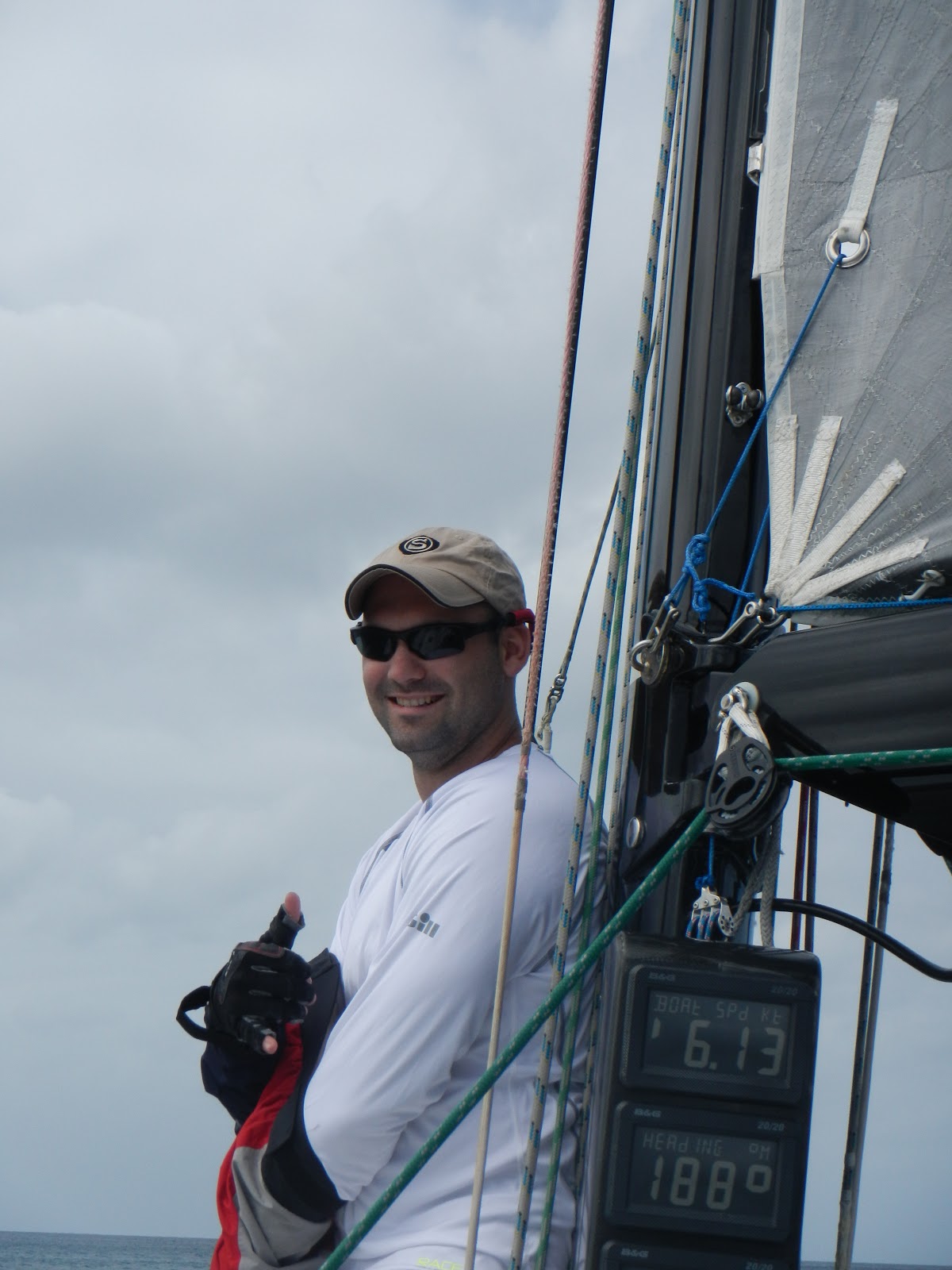
Photo:  Me


Lisa dresses in lemon yellow in case she falls overboard -- this way we will find her more easily.  That is Tom behind her -- he is an excellent hiker plus good jib trimmer.  Photo: Me

 Once the kite is up, it must be trimmed like any other sail.  My job is to control the pole that is attached to one side of the kite – this position is called the afterguy.  Associated with the afterguy are two other possible lines (ropes) – the tack line or the foreguy, these are used depending upon the type of sail we have up.  Sophie, who was color coordinating for the race in a bright orange hat, sunglasses, and matching wrist cast, was in charge of the tack line (the foreguy not being used in this particular scenario).  

Sophie, Heather and Bob -- not making sailboat racing look hard.  You can't really see the cast but the orange hat is hard to miss.  Note:  I think this photo was taken after we broke everything so while we are still "racing" we are not really racing anymore.  Photo:  Mike Fisher 

Another person controls the sheet (rope) attached to the other side of the kite (the different sides of the kite are called tacks and clews, but I figured this might get too complicated to describe further and it doesn’t really matter for this narrative anyway for the most part – I just put it in to demonstrate that I mostly know the correct names for things).   

We started out the channel with a kite up and Heartbeat behind us.  It is kind of cool to watch the boats all lined up in the channel with their sails up.

At a certain point, the channel begins to head seaward and as the direction of sail changes, meaning we need to change to a different sail.  In this case, we need to take the kite down and put a jib up.  There isn’t a lot of time in which a maneuver like this can take place, in part because we are racing and so everything is pushed as long as possible in order to maximize speed. 

We want to be fast.

Taking the sail down involves a lot of people.  Heather (our sewer person, which means she goes down below to haul the sail in) went down below and was handed the retrieving line for the sail.  Once the sail is released, the trimmer, the afterguy person, the mast person, and any other free hands rush to the low side of the boat to haul the sail in.  We are talking hundreds of square feet of sail here and depending on lots of factors, getting the sail in can be difficult.  Phillip’s job on the bow at this point is to “spike” the sail, which means he uses this metal spike thing to unclip the sail from the pole (the afterguy that I am controlling).  I HATE this part because Phillip insists on putting his head between the pole and the forestay and as you can imagine this places his head between some fairly strong forces.

Giulia, our old sewer person, whom we called the underbunny, used to say that she could tell how good a takedown was by how the kite came into the sewer.  If it came down easy, then packing it was easy (she could pack a sail in under 5 minutes).  If it came down badly, then packing it was a bitch. 

Let’s just say this one was a bitch. 

First, the tack was twisted in such a way that it would not release, despite Phillip’s best efforts, making me more nervous because his head remained in the danger zone that much longer.  This went on for much longer than we had time for and so we began to shift directions, making the inevitable takedown all that much harder.

Phillip finally was able to release the sail.  However, there was so much pressure on it, that instead of being able to pull it into the boat, it ripped away from us.  Heather, who couldn’t see any of this happening because she was down below, found herself having a rope ripped through her hands, leaving really bad rope burns in its place.

Now the sail was flying in no controlled way off the port side of the boat and we had to get it into the boat.  It took considerable time and energy to finally get the thing in and down below.  After finally getting it down and the jib up, we are on the rail and watching as Heartbeat attempts to make a move to pass us.  Some yelling about rights ensues but I don’t see most of this because after a minute or two, I go and retrieve the spinnaker bag from the bow and take it below to help Heather pack the kite because I know we are going to have to reset the kite once we exit the channel.

This picture doesn't technically fit in the narrative here, but it is really cool and I wanted to include it.  Photo:  Jeff Davis

When I get below, it becomes immediately apparent that Heather is not ok – she is in shock from the rope burns.  Because I am a bad person, I tell her that we need to pack the sail first and then I will take care of her hands.  My thinking is that if I can get her mind off her hands it will shake her out of her shock.  This does not happen and my approach does not help her.

It takes what seems like 40 minutes to pack the sail, which comes up in a knot later anyway.  Part of this time is spent being flung about the cabin like a rag doll as the boat tacks or hits a wave.  I clearly have to work on my packing skills, though having run all three sides of the kite, I still have no idea how it came up badly.

Anyway, we get the kite packed, and Heather says she is OK and will now take care of her hands. 

I believed her. 

I don’t know why I believed her because I typically am quite skeptical about everything people say to me.  I should have known she was lying.  It is a flaw in my ability to perceive reality, I know.

When she does not re-emerge, we send MikeE down to help her with her hands.  Between MikeE and Phillip they get her hands bandaged, gloves on them, and Heather rejoins the above deck world. 

Sailing continues along the coast.  Besides the big boy sailors and the foredeck people, the remainder of the crew works somewhere in the middle of the boat, we crawl over the cabin during the upwind tacks, and spend a lot of time hiking on the rail.  My job, the afterguy, is controlling the pole attached to the spinnaker, and is part of the downwind portion of a race.  During the downwind periods I am positioned in the middle of the boat clutching the guy sheet.  

This picture is of CaZan when it was still Shockwave -- not during the race I am describing.  However -- it demonstrates what the pole is and also what the boat looks like and where people would be/sit on it.  Photo: Unknown

I hold on to the afterguy even when it is tied off because of my fear that it will somehow break free, hit the bowman and crush his head.  Conversely, it could hit the forestay and break it, which will result in the mast falling down and general catastrophe.  Don’t get me wrong, my job is unimportant in the grand scale of things and amounts to pulling on a rope for about 30 seconds and then sitting there the remainder of the time, but the consequences of the afterguy failing can be serious.

My job is primarily meaningless because despite the fact I am supposed to act autonomously and control the pole based upon the wind angles, in reality if I try to make an independent decision I am immediately questioned and told I am wrong. This is how I've learned to sail.  Also, I am wrong a lot.  My own personal learning curve aside, because the pole is attached to a line that is attached to a winch that I am holding, my position remains in the middle of the boat. 

This is important for later in the story.

The first wave that crested over the bow of the boat on our downwind run came seemingly out of nowhere.  Phillip, who was driving at the time, simply said – “everybody watch out” just in time for us to looked up and see a massive wall of water in front of our faces.  We are used to getting doused by waves going upwind, but it has never happened downwind before. 

The wave hit the spinnaker trimmer, Joseph, first.  He said later that the wave fully engulfed him – and he was standing up.  He had fortunately wrapped his arm around the stanchion just prior to the wave hitting him. The boat is at least six feet above the water line.  Joseph is at least 5.8, meaning this was a pretty big wave.  The rest of us were submerged and crushed into each other and pushed into the boat.

I lost my sunglasses. 

Sophie, somehow, retained both her orange trucker hat and sunglasses [see picture above], despite being fully submerged under water.  The water gods clearly do not like orange.  She did end up with a wet bright orange cast, which I imagine got really smelly later in the week.

Massive waves coming over the boat are not all that common in the races we have done, but there really isn’t much to do about it. 

We continued to sail down wind. 

We were sufficiently behind now that we were able to watch as both LocoMotion and Heartbeat were battered by the winds we were heading towards.  LocoMotion laid on its side for an extended amount of time.  When you are not in such dire straits it is easy to look at other boats and voyeuristically enjoy their mishap. 

It is entirely different when it happens to you.

By this point we had changed from an asymmetrical sail to a symmetrical sail, one that was pretty heavy and able to withstand some powerful winds [see picture above for illustration of symmetrical sail].  We passed Turtle Bay when the winds, which had been blowing in the mid-20 knots (around 28 MPH), went to the mid-30 knots (around 40 MPH). 

As we began to feel the wind pick up Phillip kept saying, “here comes the nostrils!”   

I am not sure what this means, but at the time I interpreted it to be some sort of sailing term for really getting blown away.

When going downwind, being pulled by a massive spinnaker, it is generally a good idea to keep the bow (front of the boat) from digging into the waves.  Water is a massive drag and if the bow goes under, lets just say it isn’t a good thing. 

The call was made to get all weight (meaning people) to the back of the boat, so everyone but the spinnaker trimmer, the grinder for the spinnaker and myself were now in the back of the boat to offset the massive power of the spinnaker in the front of the boat.

It was not enough.

The first wave to break over the bow didn’t do much.

I was sitting by the afterguy mid-way up the boat, but began scooting towards the back of the boat to contribute my weight to the ballast there.

The second wave to break over the bow also seemed to subside quickly.  However, we were flying downwind and the ride was just started.

At this point we all heard a massive “bang!” Hearing things break on a boat is never good, and is especially bad in 30+ knots of wind.  While it wasn’t clear what broke, we all knew something had blown.

Only later did I learn that the spinnaker halyard (the rope holding the spinnaker to the top of the mast) had released a few feet, enough to bring the massive sail closer to the water and further push the mass of the boat downwards.

I was sitting by the driver when the third wave crashed over the bow, coursed down the side of the boat and swept me backwards.  Without letting go of the guy, I was pushed into the lifelines at the back of the boat by the wave. I knew what this looked like because I had watched a former teammate be swept in this exact way towards the back of the boat in a previous race – during what we refer to as the Kahuku slapdown.

It could also be that the boat had rounded down too, but since I was underwater, I’m not sure of the sequence.  At a certain point, I figured I was going to have to figure out how to get above the water.  Fortunately, MikeE dropped down from the high side of the boat and pulled me out of the water and the boat came out of the water on the low side around the same time.

We did this on the opposite side -- but I was at the underwater part.  This is a picture of Shockwave accomplishing the same maneuver we did -- it is not encouraged and is not fast.  Photo: Unknown
 

I don't know that we went this far over -- I just included it for the dramatic affect.  However, when I emerged from underwater, the boat appeared to be at about this angle.  Again, the same boat, but not a picture of our race -- for illustration purposes only.  Photo: Unknown
I probably have the sequence of what happens next (and also before) incorrect, because we are entering one of those Rashomon moments.  At this point, the story breaks into 11 different viewpoints, only one of which I can tell.  

Let’s just say that for the next indeterminate amount of time, all hell breaks loose. 

The spinnaker has been released and while still dragging us along is not under control. 

The pole has broken, though I am not sure when this happened (making the afterguy irrelevant).  Basically, because it is made of carbon fiber, I was told that when it touched the water it snapped. 

Finally, we are still racing in 35 knots of wind with no ability to stop. 

After a brief check to ensure that nobody was hurt and everyone was still on the boat, we all set to work getting the spinnaker down.

Mike Fisher, who normally trims the main had the (mis)fortune of driving when this all began.  All he could do was drive and watch as the remaining 10 sailors raced forward to try to pull the sail in. 

I am not sure where everyone was positioned during much of the time. 

I had my legs wrapped around the mast and was trying to help MikeE and Tom pull down the dangling  pole pieces to release the sheets from it and hopefully get a handle on pulling the thing in.  Every time we gained a few inches, however, the wind just ripped it right out of our hands. 

The other side of the sail was still attached the sheet and the guy (the other ropes) and they were wrapped around the forestay.  It seemed to me that we needed to release that pressure or we could end up breaking the forestay. 

At some point, MikeE and Phillip went forward to try to work on the sail there.  Let’s just say that at this point MikeE gained the nickname slip n’ slide and some heroic teamwork ensued.

Looking down from the mast towards the lower side of the boat, there were several people trying to pull pieces of the sail in there.  We had begun to gain some traction on the sail in the front of the boat.  I looked back and saw that the sail was now trailing in the water behind the boat so ran to the back to start pulling in the sail there.  It was at this point that I noticed the sail was completely shredded, though clearly this happened way earlier in the take down.

I was pulling in the two taped edges of the sail (these are colored so you can tell which side of the sail is which). 

As a climber, I have lots of pulling muscles.  I don’t every really lift weights, but the last time I did a lat pull, I could pull 240 pounds (well, that was when I stopped measuring).  I say this because I am not weak and pulling in those strips of sail dragging in the water took considerable energy.  Jake came back to help.

I have no idea how long this took, but we finally got the sail in the boat.

Because we were still racing, we then tried to raise our #4 jib, which had already been beaten up the day before.  It didn’t even make it half way up before it too was shredded.

We brought it back down.

We were now sailing only under the power of the main sail, but still going over 10 knots.  The race for the day was basically over for us.

Even though the wind was still loud, we all took a collective breath and began to try to figure out what had just happened.

Somebody asked – who wants a beer?

Even I couldn’t say no.

The race ended uneventfully about an hour later when we passed the land-based buoy by Mokuleia.  In theory, we had planned to round Kaena point and BBQ while motoring down the leeward coast.

It is called the leeward coast because the wind doesn’t really hit that side of the island.  We were not so lucky -- it blew around 25 knots all the way to Ko Olina and we hardly put the motor on at all.

We limped into Ko Olina, gathered up the torn sails and broken pole, cleaned up the boat, and then Jake and Phillip spent the entire evening sewing the #4 jib back into existence so we could complete the race in the morning.

Our crew normally debriefs after a race.   It is safe to say that the debrief for the second day of the race was an ongoing event – well into the evening and the next day.

Day Three:

After the second day, there really isn’t much to say about the third.  It was mostly upwind and the winds were still really high.  We missed first place by seconds and we arrived back in Honolulu with most of the boat intact, the crew mostly in one piece, and an eventful race to talk about.

During my first few years of sailing after every big event, I always looked back at it and thought – I’m glad I didn’t know it was going to be like that going in. 

I can’t say that anymore.  Two years ago, we got slapped down on the old CaZan in a similar way, but didn't’ break anything.  We called it the Kahuku slapdown.  I knew going into this race that something similar could happen.  In fact, I anticipated it.  Mike Fisher called this the Kahuku slapdown times two. 

I have heard that Hawaiians have over 200 names for the wind.  For example, olau koa is the name of a strong wind, sufficient to blow the leaves of the koa tree.  We encountered something much stronger.  Each island and each part of the island has discrete winds that are named.  I’m not sure what the name of the wind we encountered around Turtle Bay might be, but what seems clear to me now is that if I am going to keep sailing in Hawaii, it is time to learn the names of the wind and pay my respects to the power they have over our miniscule and irrelevant lives. 

Finally, I hope I can sit on my tailbone without pain before I get on a plane for Australia… being flung like a rag doll around a boat has some consequences.  

Also, stay tuned and to see what kind of trouble I can get into down under.
  

The race ended at the lantern lighting festival so I thought I would include a nice peaceful picture of lanterns.  Photo: Me